Dispatch from the War
December 18, 2023
Ted Gavin, CTP, NCPM
Managing Director & Founding Partner
Corporate Recovery
An army runs on a lot of things. A mission, a cause, its stomach; it also runs on logistics. Publicly available figures put the regular standing size of the Israel Defense Forces (IDF) at about 170,000 active troops with another 450,000 reserve personnel. Those reserve personnel were called up on October 7th, and more showed up than were called. Bases are bursting at the seams.
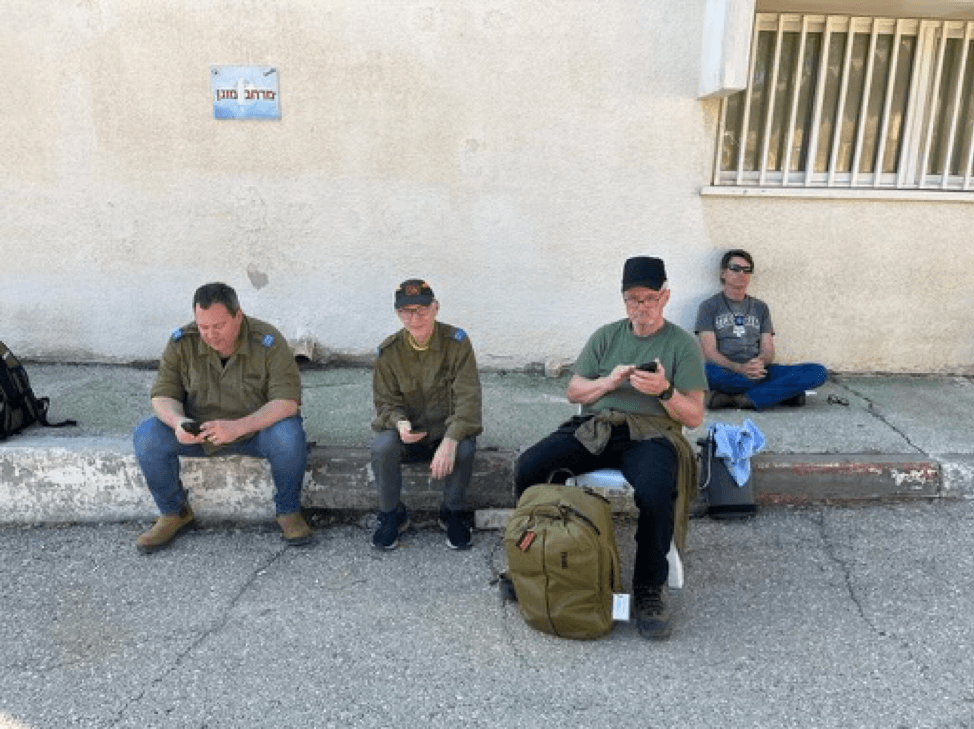
Of those troops, about 40,000 are combat troops. These soldiers must be clothed and equipped. For that, they use a cadre of military personnel, civilian personnel, and volunteers. This week, I fall into the latter category of volunteering with Sar-El. Since its inception in 1982, more than 160,000 Sar-El (the national volunteer project for Israel) volunteers from around the globe have come to Israel to provide logistical support and essential aid to the IDF.
An army deployed needs sleeping bags. When soldiers rotate back from their time on deployment, those sleeping bags need heavy-duty laundering, and they need to be checked for suitability for reassignment. You can’t have a soldier find out their sleeping bag is torn open on the inside when they go to climb into it their first night in the field. Someone needs to make sure it’s up to muster. That’s how I, and twenty other volunteers in my cohort, spent the first day assigned to one of Israel’s largest army bases and the IDF’s logistics hub.
Cleaned sleeping bags were sent from the laundry. We checked them. We healed broken zippers; we culled the stock of those with rips and tears; we rolled them, bound them, and boxed them for redeployment. There were both winter bags and summer bags—the winter bags were mainly old U.S. Army surplus. The summer bags were made of synthetic materials, and, as often as not, the zippers had long ago failed, only to be replaced with zippers from U.S. Army surplus winter bags. Four hours later, there were no bags left to process, and we headed to our barracks.
We regrouped with other cohorts for dinner, some of whom had been in the south in Be’er Sheva, some who had been on other bases, and we learned of the variety of other front-support-related work they did, like assembling and packing medical kits and sorting uniforms.
 The next day, there were kits to assemble with uniforms, duffel bags, and body armor. Body armor is at once far more straightforward and vastly more complex than one might expect. Assembling and checking body armor is nothing more than inserting armor plates into a complex web of Velcro and synthetics—yet it’s attached to someone’s life. Surprisingly, there is little armor in body armor. It is designed only to protect high-risk body areas, basically the neighborhood of the heart and lungs, front and back. It’s the difference between near-instant death and surviving the day.
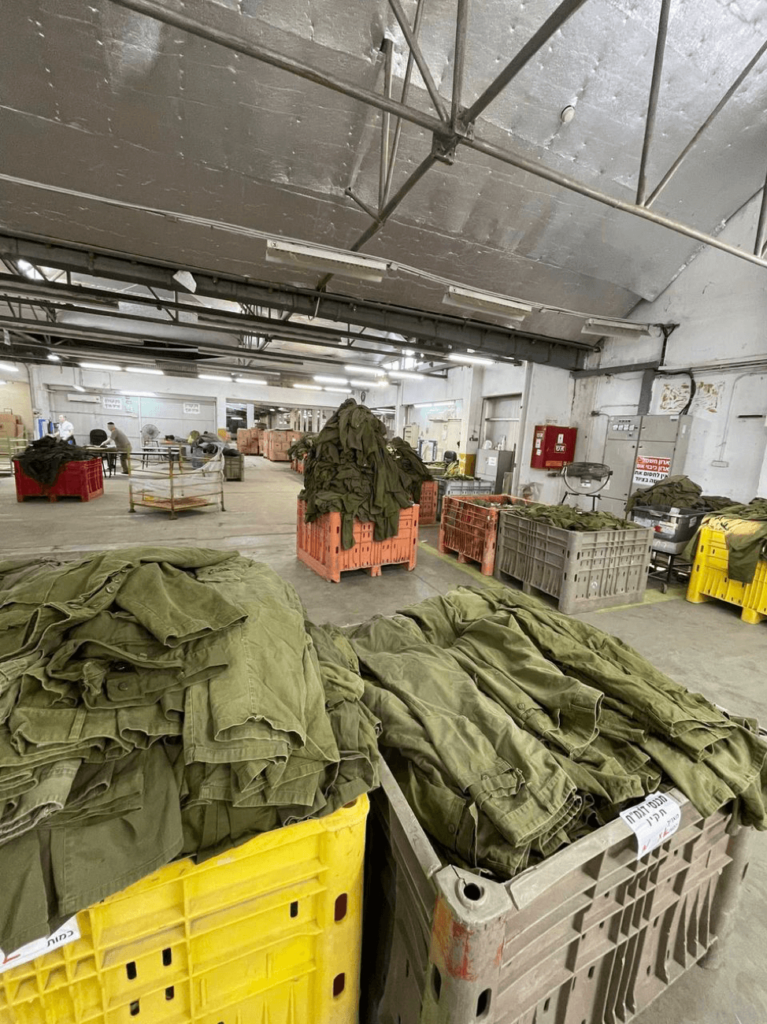 As important as the armor is, so are uniforms. Sixty thousand new civilians become eligible for military service every year in a country the size of New Jersey that happens to have compulsory service. The volunteers show up every day except during Shabbat, the Jewish holy day set aside for rest, prayer, family, and food, that begins just before sundown on Friday until sundown Saturday. And the IDF’s volunteers, which happens to include me and my Sar-El cohort, also need to be clothed so they can be identified on base. More uniforms, more PolarTec jackets, just … more.
This is a team effort, and people seem to be unified by the same goal—every volunteer here frees up a reservist who doesn’t need to be here doing this type of work. The reservists can be deployed to something more necessary (like national defense or support), or they can go home to their families and their lives just a little bit sooner. The reason I’m here, and I guess the reason we’re all here, is because if being here and doing this type of work means that a skilled volunteer or reservist can spend time supporting a family whose lives have been destroyed by the events on and after October 7th, then it’s worthwhile.

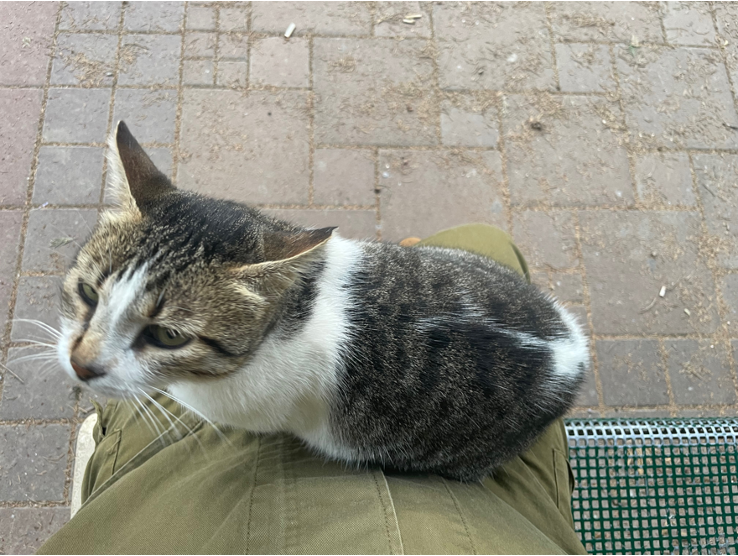
Also, and if you know me, you know this is no small thing, stray cats are ubiquitous here—they are protected by law. As someone told me when I asked about them, “In Israel, we have a lot of trash, but no rats.” The cats did not take long to figure out that I’m a cat person without cats at home for the first time in my life. Having a little feline helper to sort sleeping bags with makes it just a little bit more rewarding.